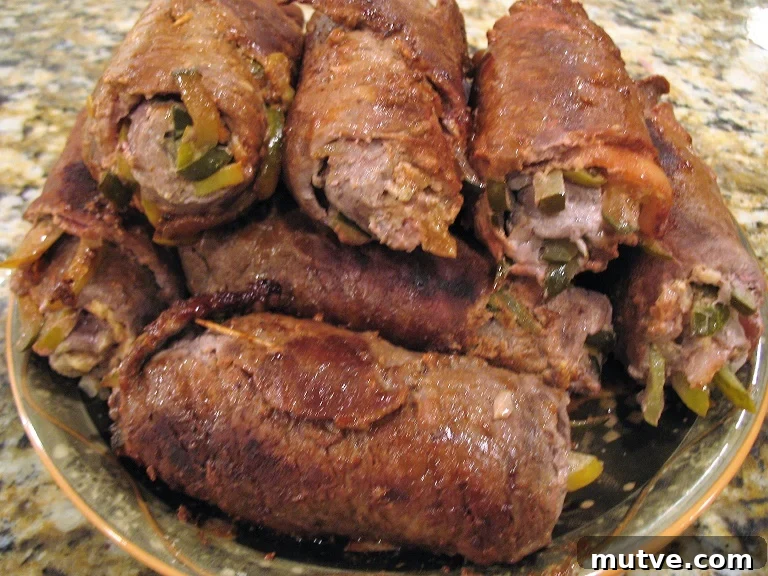
Rouladen are a classic German dish: savory beef rolls filled with mustard, bacon, pickles, and onions, browned and braised until meltingly tender in a rich gravy. (Skip to recipe.)

What special meal do you associate with Christmas Eve? Maybe a seafood platter, fondue, roast goose, or the traditional multi-course feasts found across Europe. For me, the scent and taste of Fleisch Rouladen instantly transport me back to family gatherings, warm kitchens, and the comforting chaos of the holidays.
Fleisch Rouladen — literally “meat rolls” — are thin slices of beef roast spread with mustard, layered with bacon, pickles, and onions, then seared and slowly braised in a wine-scented gravy. I make them throughout the year for special occasions, but they are essential on our Christmas Eve table, alongside sweet-and-sour red cabbage, a cucumber salad, and mashed potatoes or spätzle to soak up the sauce.
Last week I prepared eighteen rouladen and froze them, and that simple act officially put me in the Christmas mood. Rolling and filling those little parcels and then smelling them brown in the pan brought memories of holidays past — especially memories of my father.
This will be the first year we eat Rouladen without him. He loved good food: he’d sit at the head of the table, savor every bite, and watch the family gathered around with pride. As I worked, I thought of him and missed him, but I also felt grateful for the tradition he helped make so meaningful.
This year I’m hosting Christmas at our house. There will be eighteen of us over nine days — a lively mix of family, including a few teenage boys with enormous appetites. My planning revolves around keeping bellies full and energies busy. We’ll eat rouladen, light candles around the tree on Christmas Eve, sing carols, exchange gifts, and celebrate both the laughter and the tears that come with remembering those who are not with us.
* * * * *
Kitchen Frau Notes: The quantities below are given per roulade so you can scale the recipe to suit your crowd. A few extra rouladen in the freezer are a welcome midyear treat. If you want to slice your own beef, it helps if the roast is slightly frozen; otherwise ask your butcher for thin slices. Inside round is a good cut. Aim for slices between 1/8 and 1/4 inch (about 0.5 cm) thick. If slices are uneven or too thick, pound them gently with a meat mallet.
- For 18 rouladen, my butcher sliced a 3.5 kg (7.7 lb) inside-round roast; I used about 5 onions, 1.3 kg (2.5 lb) of bacon, large jars of pickles, and plenty of Dijon mustard.
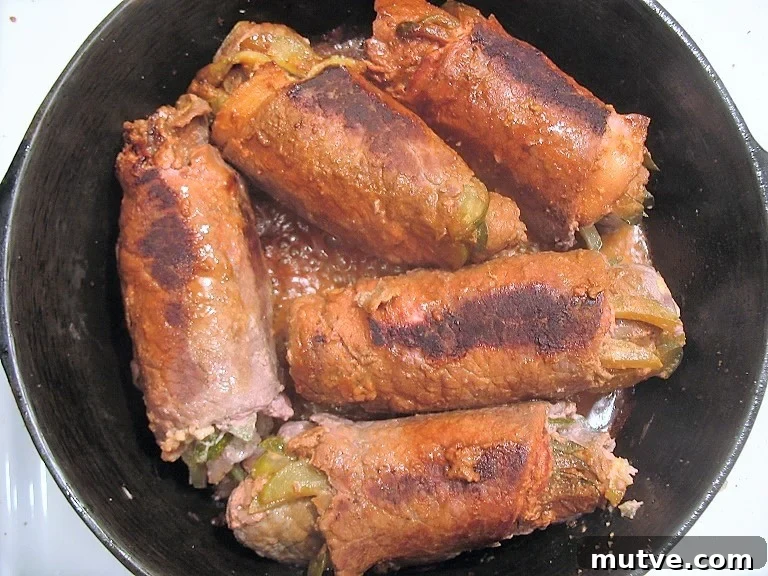
Fleisch Rouladen — The Recipe
The quantities below are approximate because rouladen vary in size and how generously you fill them. Adjust freely — more or less of any ingredient still makes a delicious result.
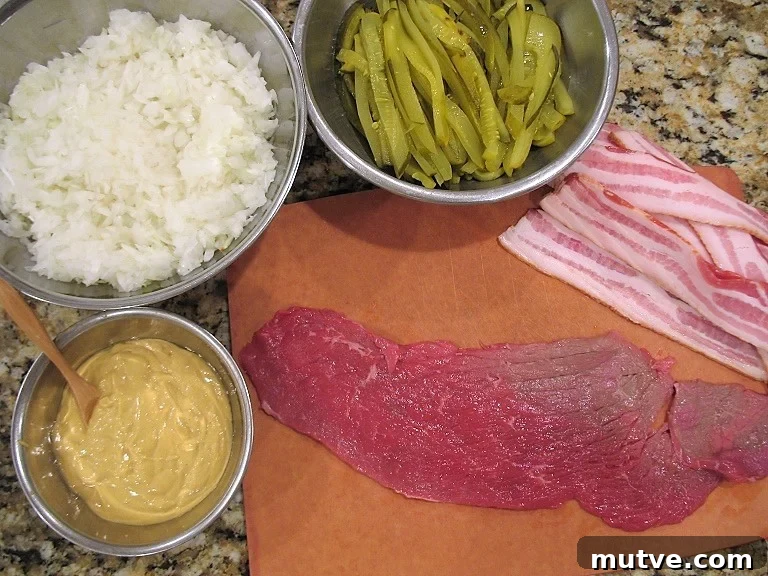
For each roulade:
- 1 thin slice of beef roast (inside round works well)
- about 2 teaspoons Dijon mustard
- 2 slices of bacon
- 4 pickle slices, cut lengthwise into long strips
- ¼ cup (60 ml) chopped onion
- toothpicks or kitchen string to secure the roll
- 1 tablespoon olive oil for browning
For the braising liquid and gravy:
- about 1 cup (240 ml) red wine
- 2 bay leaves
- 5 juniper berries or 2 whole cloves
- water to almost cover the rouladen
- salt and pepper to taste
- flour, sweet rice flour, or cornstarch for thickening
Assembly and cooking:
Lay one beef slice on a cutting board and spread about 2 teaspoons of Dijon mustard evenly over it. Place two bacon slices on top, trimming if necessary so about 2 inches (5 cm) at one end remain free of bacon. Arrange the pickle strips across the bacon and sprinkle with chopped onion, leaving the same 2-inch space near the edge.
Starting at the filled end, roll the beef up tightly, tucking the filling in as you go. Fold the unfilled edge over the roll to seal the filling and secure the roulade with a toothpick or tie with kitchen string.
Heat the olive oil in a heavy skillet over medium-high heat. Brown the rouladen on all sides until they have a deep, golden crust. Transfer them to a casserole or Dutch oven in a single layer, pouring any browned pan juices over them. Tuck in bay leaves and juniper berries or cloves, pour in the wine (liberally, if you like), and add enough water to come about three-quarters of the way up the sides of the rouladen.
Cover and bake at 325°F (about 160°C) for approximately 2 hours, until the meat is very tender. They will still be enjoyable if baked a little less time, but slow braising yields the best tenderness.
Remove the rouladen to a platter and keep warm while you make the gravy. Pour the braising liquid into a saucepan and bring to a boil. Make a slurry by shaking several tablespoons of flour (or sweet rice flour) with about ½ cup cold water in a jar until smooth, or dissolve cornstarch in cold water. With the broth boiling, whisk in slurry a little at a time until the gravy reaches your desired thickness. Taste and adjust seasoning — often no extra salt is needed because the bacon and pickles add saltiness.
Serve the rouladen with plenty of gravy to spoon over the meat and mashed potatoes or spätzle. Traditional accompaniments are mashed potatoes, potato dumplings, or spätzle, with sweet-and-sour red cabbage and a marinated cucumber salad on the side.

We hang a blown-glass pickle on our Christmas tree and the kids love hunting for it every year. It sometimes seems to move from branch to branch overnight — a bit of holiday magic.
Guten Appetit!
If you enjoy these recipes, consider signing up for the Kitchen Frau newsletter to receive new recipes and a handy kitchen tip with each one. Follow Kitchen Frau on social media to see more cooking inspiration and updates.
You might also like:
German Style Sauerkraut – Schmeckt Wunderbar!
A Typical German Meal – Authentic Recipes
German Potato Salad
German Style Sweet and Sour Lentil Eintopf