My friend Emma has started a project she calls Project Nosh to eat as many of the edible plants in her garden as possible before she moves. One of the plants she wants ideas for is French tarragon, botanically Artemisia dracunculus. The specific name dracunculus translates roughly as “little dragon,” a traditional reference that may allude to the toothed leaves or the plant’s long, twisting roots. I promised to share a simple tarragon vinegar recipe so Emma can preserve that warm, anise-like flavour and take it with her.
Below I cover how I grow and propagate tarragon in a polytunnel and then provide a straightforward recipe for making tarragon-infused vinegar.
Tips how to grow tarragon
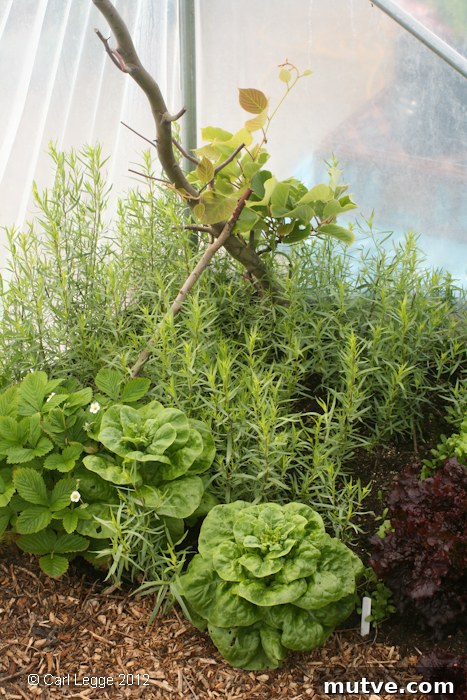
The tarragon pictured was divided and moved from my smaller polytunnel into a larger one in spring, and it recovered very well. Tarragon responds positively to being split every few years, and divisions make excellent gifts for other gardeners. This year I sent plants as far afield as Rome, Wiltshire and Hertfordshire.
I am planting the large polytunnel as a kind of forest garden. For tarragon this means situating the plants beneath a kiwifruit variety and surrounding them with companion plants such as lettuces, a strawberry and nasturtiums. I also sowed fenugreek nearby as a green manure and for culinary use as methi.
French tarragon emerges from its roots in spring and can send up stalks approaching a metre high, flowering in late summer before the aerial parts die back over winter. Outdoors it can be somewhat variable: some winters see it through, others not. For greater winter protection I now grow it in a polytunnel. Tarragon spreads by root, so if you plant it outside give it generous space or grow it in a pot so it can be moved indoors when temperatures fall.
When harvesting, avoid removing more than two-thirds of each stalk at a time; the plant will resprout from the leaf axils. You can propagate tarragon by dividing the root clump in spring or by taking stem cuttings in summer. Note that true French tarragon does not produce viable seed; seed labelled as tarragon is usually the hardier Russian variety, which has a different flavour profile.
Tarragon vinegar recipe
This recipe makes about 500 ml of tarragon vinegar. It scales up or down easily if you want to make a larger batch.
Ingredients
500 ml white wine vinegar or cider vinegar
2–3 sprigs of fresh French tarragon, each shorter than the bottle height, washed if necessary and thoroughly dried (leave the leaves attached to the stalks)
1 extra sprig of tarragon to mark the bottle after infusion (or label the bottle)
Method
Gently warm the vinegar in a saucepan until it feels just warm to the touch but does not boil — roughly 40°C is a useful target. The slight heat helps release the volatile oils that carry much of the herb’s aroma and flavour, giving a fuller infusion. This step is helpful but optional.
Place the tarragon sprigs into a clean bottle and pour the warmed vinegar over them. Seal the bottle and set it on a sunny windowsill. Give it a gentle shake every day or two and allow the flavour to develop for 2–3 weeks.
After infusion, remove the original sprigs and replace one fresh sprig to identify the bottle, or simply label the container. With some herbs you may need to strain the vinegar through muslin or a fine filter before re-bottling, but tarragon usually leaves little debris.
Uses & variations
Tarragon vinegar is excellent in vinaigrettes and homemade mayonnaise and pairs beautifully with green beans, fish and chicken. The aromatic, slightly sweet-anise character of tarragon complements delicate proteins and bright salads.
The same technique works with many other fresh herbs and edible flowers. Try lavender, pinks, nasturtiums, elderflowers, primroses, violets or roses to capture floral notes for use in dressings and marinades. Vinegar infused with seasonal garden herbs is an easy way to preserve and amplify summer flavours for use year-round.