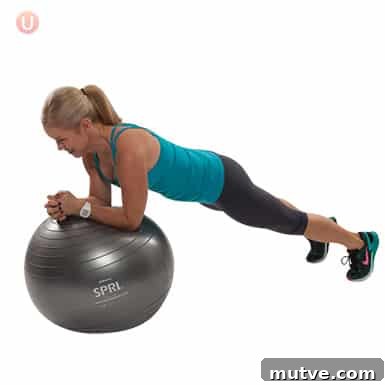
The Stability Ball Forearm Plank is an advanced core exercise that demands stability, balance and full-body tension. Unlike a floor plank, performing this variation on a stability ball forces your body to recruit deeper core muscles — especially the transverse abdominis — along with the glutes, hips and legs to maintain alignment. If you want a more challenging plank that improves posture, spinal support and overall body control, this move delivers results beyond ordinary crunches or sit-ups.
Using a stability ball creates an unstable surface, which increases neuromuscular engagement and forces more muscle fibers to activate to keep you steady. Because the body must continually adjust to the ball’s movement, the exercise strengthens both the prime movers and the small stabilizing muscles around the spine, shoulders and hips.
This exercise is included in our core-focused routine “Use The Ball, Lose the Belly Core Workout” and complements full-body programs like the Stability Ball Total Body Toner. It’s an excellent addition to workouts aimed at building functional strength and better posture.
Stability Ball Forearm Plank Instructions
- Start kneeling with the stability ball in front of you and your forearms resting on top of the ball.
- Draw your belly button toward your spine and engage your transverse abdominis. Press your forearms into the ball and lift your knees off the floor until your body forms a straight line from head to heels.
- Keep your shoulder blades down and back, neck neutral, and avoid letting the hips sag or pike up.
- Hold the plank while breathing steadily, maintaining tension through the glutes, thighs and core.
Targets: core, shoulders, back
Benefits of the Stability Ball Forearm Plank
This plank variation offers several advantages over floor planks:
- Greater core activation, especially the deep stabilizers that support the lower back.
- Improved balance and proprioception from working on an unstable surface.
- Enhanced shoulder and upper-back stability due to the need to control the ball.
- Progression for anyone ready to move beyond basic plank holds and build functional strength.
Common Mistakes and Cues
To get the most from the Stability Ball Forearm Plank and avoid injury, watch for these common errors:
- Hips sagging: If your hips drop, pull the belly in tighter and squeeze the glutes to maintain a straight line.
- Piked hips: Don’t lift the hips too high; focus on a long, neutral spine.
- Tight neck or raised shoulders: Keep the neck relaxed and shoulders pressed down away from the ears.
- Holding breath: Breathe evenly throughout the hold to maintain tension without bracing uncomfortably.
Modifications and Progressions
If you’re new to the exercise or need to regress for safety, try these options:
- Knees on the floor with forearms on the ball — reduces load while preserving the instability challenge.
- Perform a plank with forearms on the floor before moving to the ball to build baseline core strength.
When you’re ready to progress, increase hold time, slow any controlled arm or leg movements from the plank position, or try single-leg lifts while maintaining plank alignment.
Safety Tips
- Warm up before attempting advanced core work to prepare muscles and joints.
- If you have recent shoulder, neck or lower back injuries, consult a healthcare professional before trying this variation.
- Use a properly inflated stability ball sized for your height so you can maintain good form.
Sample Set and Rep Guidelines
For general fitness, aim for 3 sets of 20–45 seconds with 30–60 seconds rest between sets. Beginners can start with 3 sets of 10–20 seconds or use the knee-modified version. As strength and stability improve, gradually increase hold time or add controlled movements to raise the challenge.
Incorporating the Stability Ball Forearm Plank into your routine enhances core stability, balance and functional strength. Focus on quality of movement, steady breathing and progressive overload to gain the most benefit from this highly effective exercise.